
Space Waves
How To Master Space Waves Gameplay Mechanics
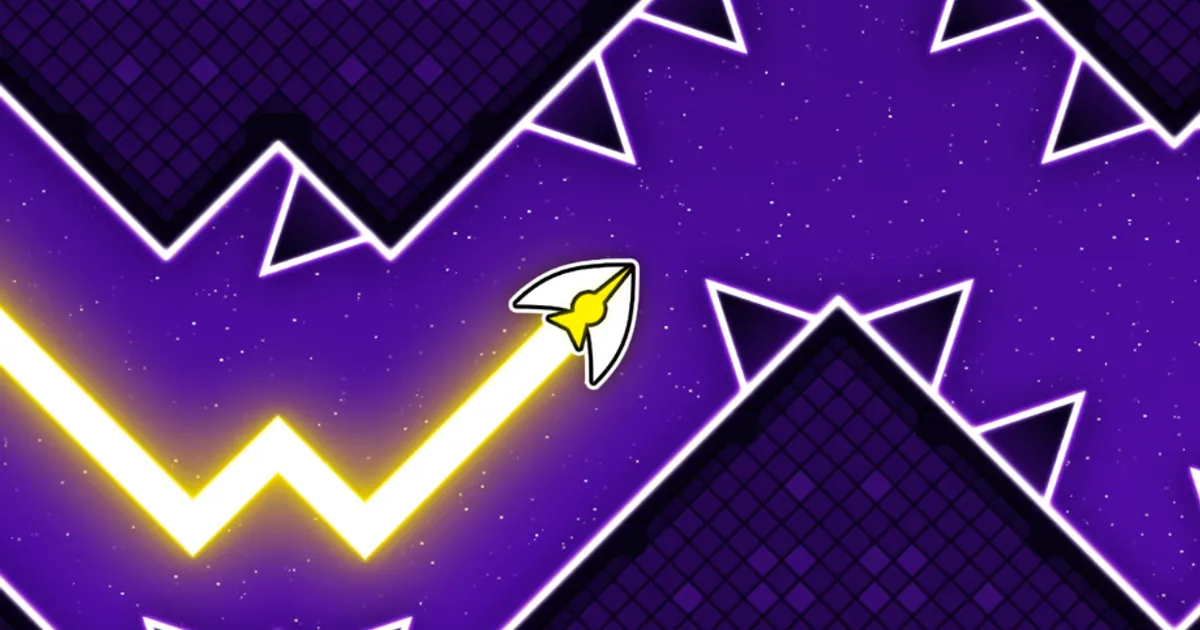
Pressing the primary input instantly locks your glowing arrow into a rigid, 45-degree upward trajectory. Releasing the input immediately reverses this vector, plunging the avatar downward at the exact same angle. These binary physics form the foundation of every maneuver required to survive the neon-drenched corridors. Players must internalize this constant momentum to avoid shattering against jagged barriers.
To truly master Space Waves gameplay mechanics, one must stop reacting and start anticipating. The scrolling viewport demands absolute precision, punishing erratic clicks with instant destruction. You must break down the control scheme into actionable micro-movements:
- Ascension Hold: Maintain pressure on the left mouse button or spacebar to climb steadily toward the ceiling.
- Descent Release: Lift your finger completely to initiate a sharp, unyielding dive toward the floor.
- Oscillation Tapping: Rapidly alternate inputs to hover horizontally through extremely narrow gaps.
Understanding these inputs separates novices from veterans. When you decide to play Space Waves online, expect a brutal learning curve that rewards muscle memory above all else.
The 45-Degree Trajectory Rule
Every movement strictly adheres to a fixed diagonal grid. Unlike traditional platformers featuring variable jump arcs, this arcade challenge enforces absolute mathematical consistency. Your speed remains static, meaning survival depends entirely on timing rather than velocity control. The engine calculates your position frame by frame, leaving absolutely zero margin for error when approaching tight corners.
Misjudging the apex of a climb by a single millisecond results in catastrophic collision. The unforgiving nature of the collision detection means that even a pixel of overlap with a hazard triggers an instant reset. To conquer Space Waves tracks, players must visualize invisible zig-zag lines overlaying the screen. You are not just reacting to the immediate environment; you are plotting a continuous, unbroken path through a constantly shifting maze.
"Do not track the avatar itself; focus your eyes on the empty space halfway across the screen to anticipate the next required pivot."
Micro-Tapping Versus Sustained Holds
Navigating tight horizontal tunnels requires abandoning long, sweeping movements. Instead, execute high-frequency micro-taps to force the arrow into a rapid flutter. This technique minimizes vertical displacement, allowing safe passage through claustrophobic sections. Your finger must act like a rapid-fire piston, maintaining a delicate equilibrium between gravity and thrust.
Conversely, sprawling open areas demand confident, sustained holds. Hesitation during a major ascent will clip the tail end of your avatar on trailing spikes. The game frequently baits you into over-committing to a dive, only to present a sudden, sheer wall immediately afterward. Those who play Space Waves online frequently discover that swapping between these two rhythms is the ultimate test of cognitive flexibility. Mastering this duality is what separates those who rage-quit from those who dominate the leaderboards.
Telemetry Data And Calibration Parameters
| Developer Studio | do.games / CrazyGames |
| Core Engine | Unity 6 WebGL |
| Primary Input | Left Mouse / Spacebar / Touch |
| Available Modes | Classic (33 Stages), Endless, Racing |
| Physics Model | Constant Velocity Diagonal Trajectory |
Reviewing the technical specifications reveals the streamlined nature of the architecture. The developers stripped away complex inventory systems, focusing purely on reflex-driven input loops. This minimalist design ensures zero input lag, a critical factor when dodging razor-sharp obstacles at high speeds.
You can tackle 33 distinct Space Waves levels in the Classic mode, each introducing progressively denser hazard configurations. The engine runs flawlessly in modern browsers, delivering high frame rates essential for split-second adjustments. Dropped frames equal dropped runs, making optimized performance a core pillar of the experience.
Navigating Geometric Hazards And Hitboxes
The neon aesthetic masks a ruthless collision detection system. The arrow's hitbox extends slightly beyond its visual boundaries, meaning near-misses often register as fatal impacts. Memorizing hazard behaviors is mandatory for progression. You cannot rely on luck; every death is a direct result of a miscalculated input.
You will encounter three primary obstacles while attempting to conquer Space Waves tracks across the different worlds. The environment is actively hostile, designed to force errors through deceptive spacing.
- Static Walls: Unforgiving vertical and horizontal blockades requiring precise altitude adjustments to bypass.
- Rotating Gears: Dynamic hazards that demand timing your pass during the exact apex of their rotation cycle.
- Serrated Spikes: Floor and ceiling traps that instantly punish over-extensions during ascents or descents.
Entering a new zone means recalibrating your approach to these threats. The transition from basic static mazes to dynamic, moving gauntlets will test even the most hardened reflexes. Spatial awareness becomes your most valuable asset.
Identifying Safe Zones
Amidst the chaotic geometry, brief pockets of safety exist. These temporary respites allow you to reset your mental metronome before the next barrage of traps. Identifying these zones requires looking past the immediate danger and scanning the right edge of the screen. Advanced players use these milliseconds of downtime to adjust their grip and steady their breathing.
When grinding through the grueling 33 Space Waves levels, these safe zones become your only opportunity to blink. Never linger too long; the constant forward scrolling will quickly push you back into the grinder. The pacing is relentless, demanding a state of flow where conscious thought is replaced entirely by instinctual reaction.
Managing Visual Overload
The pulsating backgrounds and glowing particle effects intentionally distract the eye. As difficulty scales, the visual noise intensifies, attempting to break your concentration. Tunnel vision is your greatest enemy in this environment, often leading to avoidable crashes against peripheral obstacles.
To combat sensory overload, dial down the ambient lighting in your physical room and focus strictly on the contrast between the hazards and the background. Implementing the best Space Waves speedrun strategies requires filtering out aesthetic fluff to see the raw geometry underneath.
- Peripheral Tracking: Let your peripheral vision handle the immediate obstacles while your central focus maps the upcoming route.
- Color Coding: Recognize that shifting hues often signal an impending change in hazard density or speed.
- Blink Synchronization: Time your physical blinks during safe zones to maintain unbroken visual contact during intense maneuvers.
Establishing Rhythm Within Neon Corridors
This experience is secretly a rhythm game disguised as a physics runner. Every successful maneuver generates a steady, hypnotic cadence of clicks and releases. When you fall out of sync with this hidden beat, failure is imminent. The visual layout directly corresponds to the underlying tempo.
To execute the best Space Waves speedrun strategies, you must memorize the auditory cues tied to specific obstacle patterns. Muscle memory takes over when your conscious mind cannot process the visual data fast enough.
"Treat your mouse button like a percussion instrument. If the rhythm feels erratic, your trajectory is already compromised."
Audio-Visual Synchronization
The electronic soundtrack is not merely background noise; it provides subconscious timing hints. Major structural shifts in the environment often align perfectly with bass drops or tempo changes. Leaning into this synchronization transforms frantic dodging into a choreographed dance of light and sound.
Those who successfully conquer Space Waves tracks do so by letting the music guide their thumbs. Muting the audio strips away a vital layer of sensory feedback, making tight corridors significantly harder to navigate. The auditory feedback loop reinforces successful movement patterns.
Momentum Conservation In Endless Mode
Beyond the structured campaign lies a procedural gauntlet designed to break your endurance. Here, the difficulty ramps up infinitely, combining all previously encountered hazards into unpredictable configurations. Survival demands aggressive momentum conservation. You cannot memorize the layout; you must read and react to the incoming geometry in real-time.
You must string together flawless micro-taps and sweeping arcs without hesitation. Every time you play Space Waves online in this mode, the procedural generation ensures no two runs are identical. The true test lies in adapting your established rhythm to entirely foreign obstacle layouts on the fly. Pushing your high score requires entering a trance-like state where the mechanics fade away, leaving only pure, unadulterated focus.
Frequently Asked Questions About Space Waves
How do I beat the extremely narrow horizontal tunnels without crashing?
You must employ the micro-tapping technique. Instead of holding the input, rapidly click or tap the screen at a high frequency. This forces the glowing arrow to oscillate quickly in place, maintaining a relatively flat horizontal trajectory without gaining dangerous altitude.
Why does my arrow feel like it is moving too fast in the later stages?
The forward scrolling velocity remains constant, but the density of the obstacles increases drastically. This creates an optical illusion of increased speed. To counter this, shift your visual focus further to the right side of the screen to give your brain more time to process the upcoming geometry.
Are there any checkpoints during the harder stages?
No, the core loop demands flawless execution from start to finish. If you crash, you instantly restart from the beginning of the stage. The key to mastering the 33 Space Waves levels is building unbreakable muscle memory through repeated, rapid failures.